

Does Your Child Need an Eye Exam?
It is not always obvious when a child needs glasses. Children rarely complain about their vision, largely because they have nothing to compare it against. Blurry text, tired eyes or words that seem to jump around the page can feel completely normal to a child who has never known anything else. As adults we have years of reference to draw on, so we notice when something is off. Children usually do not, so the signs tend to show up in behaviour rather than in words. Here are eight of the more common signs that it might be time to book an eye test.

Headaches or Sore Eyes
Has your child come to you complaining of a headache or sore eyes, particularly after school or homework? When vision is not quite right, children often overwork their eyes to focus or to see through the blur, and that extra effort can leave them with a sore head or tired eyes by the end of the day.
Losing Their Place When Reading
You might notice, when you read together, that your child skips words or whole lines, or uses a finger to keep their spot. It is easy to put this down to carelessness or impatience. In many cases, though, a visual processing issue such as poor eye tracking is making it genuinely hard for the eyes to move smoothly across the page.
Reversing Letters or Words
Reversing letters is common in children up to around age seven, so on its own it is usually nothing to worry about. People often assume that writing letters backwards is a sign of dyslexia, but that is frequently not the case. When it persists, a visual processing issue can be one of the contributing factors worth ruling out.
Squinting
Squinting can be a sign of a refractive error, which is when the shape of the eye stops light focusing neatly on the retina. Narrowing the eyes can briefly sharpen the picture, which is why children do it without realising. Refractive errors range from astigmatism through to myopia, the term for short-sightedness, and all are readily picked up in an eye test.
Sitting Too Close to Screens or the Television
Have you noticed your child holding a tablet or phone right up to their face, or edging closer and closer to the television? Some children even drop their head down toward the screen. This can be a sign of myopia, where things become clearer only when they are brought in close.
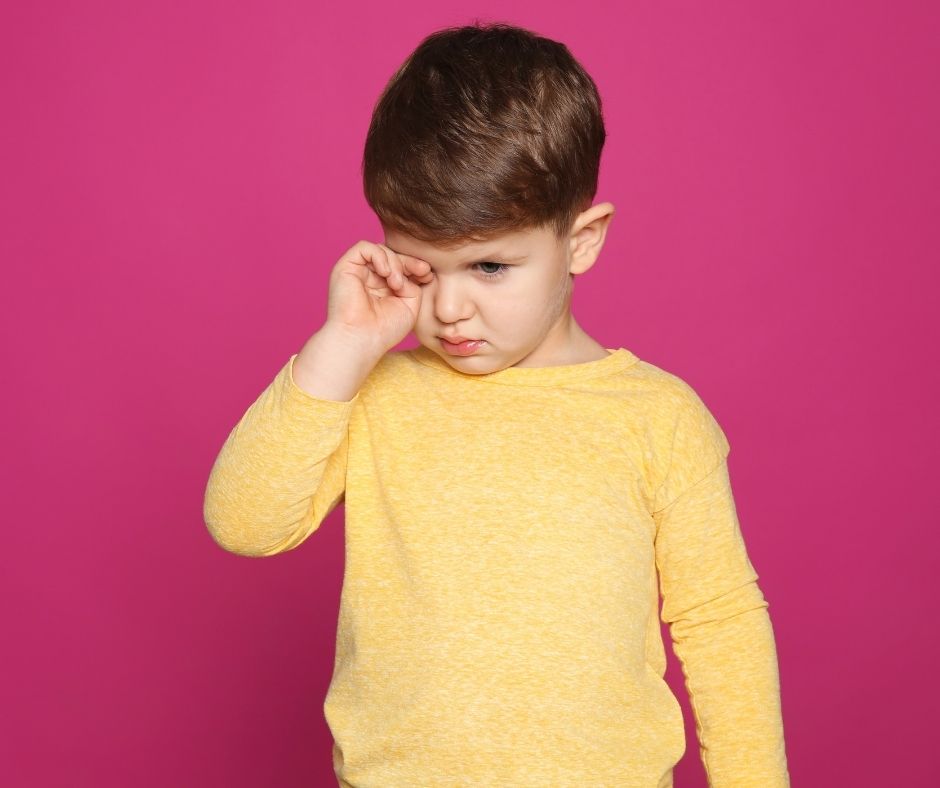
Constant Eye Rubbing
The occasional rub is nothing to read into, but frequent eye rubbing can point to eye strain or general tiredness of the eyes. It can also flag other issues, from a simple infection such as conjunctivitis through to something that warrants a closer look. If it is happening often, it is worth having checked.
Covering One Eye
If you notice your child covering one eye, or tilting their head to look at something, they may be trying to adjust the angle so they can see more clearly. This can be a sign of amblyopia, often called lazy eye, which is one of the more common vision conditions in children and responds well when it is picked up early.
Trouble Concentrating
Plenty of children find it hard to concentrate from time to time, and it is certainly not always about vision. But if a teacher has mentioned that your child’s attention drifts in class, it is worth considering whether the eyes are part of the picture. In a classroom, a child constantly shifts focus between the page on their desk, the teacher, and the board at the front of the room. If the eyes struggle to switch between near and far quickly, that steady effort can be tiring and pull their attention away from the work.
Trust Your Instincts as a Parent
You know your child better than anyone, and you are often the first to sense when something is not quite right. None of the signs above proves there is a vision problem on its own, and many have other everyday explanations. But if you notice a few of them together, or one that keeps cropping up, it is a good prompt to have your child’s eyes checked. A test brings peace of mind either way, and if there is something to address, catching it early makes a real difference to how comfortably your child reads, learns and plays.
So What Should You Do?
The simplest way to find out whether your child has a vision problem is to book them in for an eye test. Even if your child already wears glasses, a check every twelve months helps us keep the prescription current as they grow. A thorough test looks well beyond whether they can read the letters on a chart, taking in how the eyes work together, focus and track across a page.
Why See a Behavioural Optometrist?
At Eyes By Design we are behavioural optometrists, with additional training and qualifications in how children see and make sense of what they see. That means we assess not only clarity of sight, but also eye teaming, focusing and tracking, the skills that matter so much for reading and learning. We have been examining children, prescribing, fitting and dispensing eyewear on the Central Coast for close to twenty years, and we take the time to get things right.
In some cases, vision therapy may be recommended to help develop visual and visual information processing skills. Where that is the case, we will explain what is involved and what it aims to support, so you can make an informed decision for your child.
My Child Needs Glasses, Now What?
If your child needs glasses and feels a little anxious about the idea, you are not alone, and there is plenty you can do to help. Have a read of our companion guide, Tips to Help Your Child Love Their Glasses, for practical ways to make the change an easy one.
We Are Here to Help
Choosing and fitting the glasses is only part of what we do. We are also here for the adjustments and small repairs that come with active children, and all glasses sold at Eyes By Design carry a minimum twelve month warranty on the frame, with some brands extending that to two years. As your local Kincumber optometrists, our aim is to support your child’s vision now and as they grow.
Frequently Asked Questions
How Often Should Children Have an Eye Test?
As a general guide, children should have an eye test every twelve months, or sooner if you notice any of the signs above or your optometrist recommends it. Regular checks help us keep up with the changes that come with growth and with the demands of school.
Can My Child Have a Vision Problem and Still Pass a School Screening?
Yes. A school screening usually checks distance vision only, so it can miss issues with focusing, eye teaming and tracking, the near vision skills that matter most for reading and classroom work. A full eye test with an optometrist looks at how the eyes work together, not just how far down the chart your child can read.
At What Age Should My Child Have Their First Eye Test?
If you have not noticed any concerns, a good milestone is an eye test before your child starts school, so any issues can be picked up before they affect learning. Of course, if you notice a sign at any age, there is no need to wait, and you are welcome to book a test sooner.
This article is intended to promote understanding of and knowledge about general eye health topics.
It should not be used as a substitute for professional advice, diagnosis or treatment.
Always seek the advice of your health care professional prior to incorporating this as part of your health regimen.

Dr Nicholas Altuneg
Since graduating in 1993, my greatest passion has been helping people of all ages live improved lives through better vision. At Eyes by Design, vision is so much more than being able to see clearly or read small letters from far away; it determines your perceptions and reactions every second of the day.
Read more about Dr Nick
Our Vision Services
Get In Touch
Contact us today


