

When people choose new glasses, they usually focus on two things: the prescription and the frame.
That makes sense. The prescription determines how light gets corrected, and the frame is what you see in the mirror. Both deserve careful thought.
What a lot of people don’t realise is that a third factor can significantly affect how glasses feel and perform: the lens design itself.
Two pairs of glasses can share the exact same prescription yet still feel surprisingly different to wear. One feels comfortable almost immediately, while the other leaves the wearer strained, aware of distortion, or unsure why the glasses never quite feel natural.
Often, the difference isn’t the prescription at all; it’s how the lenses were designed to meet that person’s specific needs.
At Eyes by Design, Dr Nicholas Altuneg (Dr Nick) often sees this: modern lenses are far more sophisticated than most people realise, and lens design can shape how smoothly your vision works across distances, how stable the world feels when you move, and how comfortable your eyes are by the end of the day.

A prescription tells us what needs correcting, not how the lens should be built
A prescription is the starting point for every pair of glasses.
It tells us how to adjust the light so it focuses clearly on the retina through the lens’s optical centre. That’s essential, but it doesn’t mean every lens made to that prescription performs the same way.
Lens design involves more than plugging prescription numbers into a piece of material. It’s also about how the lens manages vision across its entire surface, how it behaves away from the optical centre, how smoothly it transitions between viewing zones, and how well it supports the wearer.
The prescription tells us what needs correcting. Lens design plays a major role in how that correction is delivered, and that difference matters most for people who wear their glasses all day, work at multiple distances, or are sensitive to visual discomfort.
Not all lenses are designed the same way
It’s a reasonable assumption that lenses are all much the same once a prescription is added. However, lenses can be built using very different optical approaches.
More conventional designs rely on standard assumptions and average values. That works reasonably well for many people, but it doesn’t account for the fact that every eye is unique.
More advanced lenses take a more personalised approach, factoring in additional information about the wearer’s eyes and how the frame will sit on their face, which can meaningfully improve comfort and performance.
At Eyes by Design, that’s why lens recommendations are made carefully rather than routinely. The goal isn’t just technically correct glasses; it’s glasses that feel natural and perform well in real life.
Why some glasses feel easier to adapt to than others
Most people adjust to new glasses without much trouble. Occasionally, though, someone puts on a new pair and immediately feels something is off.
They might describe the lenses as ”strange,” ”different,” or ”not as comfortable as my old pair.” Sometimes there’s edge blurring, a sense of distortion while walking, or heightened awareness of the lenses when switching between tasks.
That’s not always down to an incorrect prescription.
Lens design affects how easily the brain adapts to a new pair of glasses. When the optics are managed more smoothly and precisely across the lens, the visual experience tends to feel more stable and intuitive. This is why one pair can feel effortless while another with a near-identical prescription never quite settles.
The role of biometric lens design
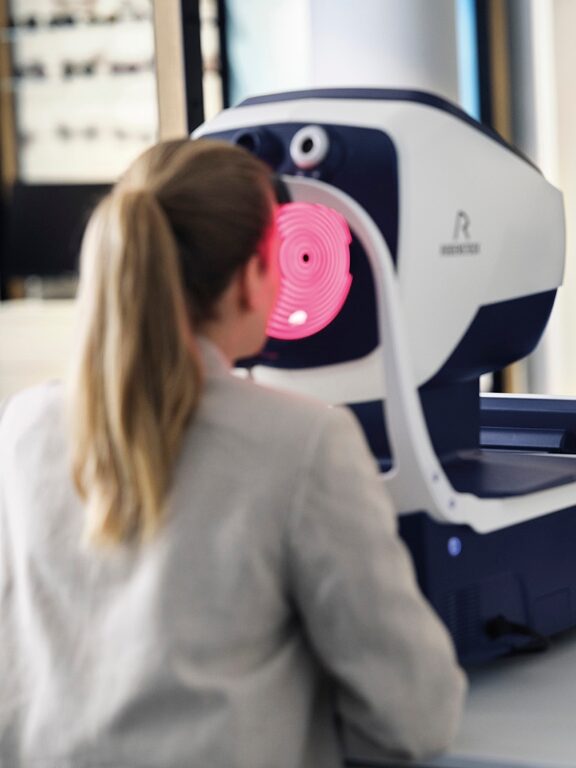
One of the bigger developments in modern eyewear has been the use of biometric data to inform lens design.
Biometric technology uses detailed eye data so lenses can be tailored to your eye’s actual structure and optical behaviour, rather than an average.
Technologies such as Rodenstock biometric lenses work on this principle. Instead of assuming one eye behaves much like the other, they use real eye data to build a more individualised lens.
This isn’t about making lenses more complicated for the sake of it. It’s about closing the gap between what a lens is designed to do in theory and how it performs for a real person in everyday life. For some patients, the benefit is subtle. For others, particularly those with higher visual demands, the added precision means greater comfort, easier adaptation and a more natural visual experience.

Lens performance also depends on how the frame holds the lens
Even a well-designed lens still needs to sit properly in front of the eye.
That’s why careful frame fit and lens positioning matter just as much as the lens design itself. At Eyes by Design, careful dispensing and more advanced measurement systems are integral to the process, so the lens design is considered alongside the chosen frame, and the final glasses support the way the wearer uses their vision.
That more comprehensive approach is what keeps lens performance intact once the glasses leave the consulting room and become part of everyday life.
Why lens design matters more today
Modern life puts a lot of strain on our eyes.
Glasses are expected to support a wide range of visual tasks, often for extended periods, which is exactly why lens design matters more than it used to.
Small differences in optical performance may not have been as noticeable in a less visually demanding world. Today, they can shape how comfortable you feel by the end of the day and how effortlessly your glasses keep up with modern life.
Vision, Done Properly
At Eyes by Design, lens selection isn’t treated as a routine transaction.
It’s part of the broader philosophy of Vision, Done Properly, an approach built on the understanding that good vision depends on more than updating a prescription. It also depends on how lenses are designed, how accurately they’re matched to the wearer, and how well the finished glasses support daily visual demands.
Dr Nick often says the best eyewear solutions come from understanding the whole system: the eyes, the lens design, the frame, and the life of the person wearing the glasses.
Supporting confident vision for life
Over 80% of the information we take in from the world is visual. For most people, glasses are worn all day and relied on for everything.
When lens design is chosen thoughtfully, glasses can feel more natural, stable, and supportive all day.
If you’ve ever wondered why some glasses feel better than others, lens design is often a big part of the answer.
At Eyes by Design, Dr Nick and the team take the time to understand each patient’s visual needs, so lenses, frames and eye care work together to support confident vision for life.
FAQ
Are all glasses lenses the same once the prescription is added?
No. Different lenses can be designed in very different ways, which can affect clarity, comfort, adaptation and how smoothly vision works across the lens.
What is biometric lens design?
It uses detailed information about your eye to build a more personalised lens, rather than relying on standard average models.
Why do some new glasses feel easier to adapt to than others?
Prescription is one factor, but lens design, frame position and how closely the optics match the wearer all influence how natural new glasses feel.
Does better lens design really make a difference?
For many people, yes, the benefits include smoother vision, less strain, easier adaptation, or a more natural visual experience throughout the day.
This article is intended to promote understanding of and knowledge about general eye health topics.
It should not be used as a substitute for professional advice, diagnosis or treatment.
Always seek the advice of your health care professional prior to incorporating this as part of your health regimen.

Dr Nicholas Altuneg
For over two decades, my greatest passion has been helping people of all ages live improved lives through better vision. At Eyes by Design, vision is so much more than being able to see clearly or read small letters from far away; it determines your perceptions and reactions every second of the day.
Read more about Dr Nick

Our Vision Services
Get In Touch
Contact us today


